 Optencis

An inflation figure, a jobs report or a central bank decision can move a currency pair more in five minutes than in the rest of the day. For a binary options trader, that is both the clearest movement of the day and the most chaotic. Here is how to approach it: what to prepare, when to trade, and when to stay out.
News only moves real-market assets
Economic releases move the real market: currency pairs, gold, stock indices. They do not apply in the same way to OTC assets, whose price comes from the platform itself. Trading EUR/USD OTC because a US figure just came out makes no sense. See what changes with OTC assets.
Before the release: prepare
- Check the calendar. Our economic calendar shows each release, its time and its expected impact.
- Note the forecast and the previous figure. The market has already priced in the forecast: only the gap between the actual figure and the forecast moves prices.
- Know which assets will react. A US release moves the dollar pairs, gold and US indices; an ECB decision moves the euro; a Bank of England decision moves the pound.
Read the surprise
- Figure well above the forecast on inflation or jobs: the market expects higher rates for longer, and the currency usually rises.
- Figure well below: the opposite.
- Figure in line with the forecast: often little movement, or a move driven by details.
Some reports contain several figures that can point in different directions. The US jobs report gives jobs created, the unemployment rate, wages and revisions of the previous months: when they disagree, the first move often reverses within minutes.
Three ways to trade it
| Approach | What you do | Our view |
|---|---|---|
| Before the release | Open a trade a few minutes before, guessing the figure | Avoid: it is a guess, not an analysis |
| At the second of the release | Open a very short trade as the figure comes out | Avoid: prices jump in both directions, the result is largely chance |
| After the first reaction | Wait 5 to 15 minutes, then trade in the direction the market has confirmed | The most reasonable approach |
Staying out entirely during big releases is also a sound choice, especially while you learn. Missing a move costs nothing; trading the chaos often does.
Choose a longer expiry
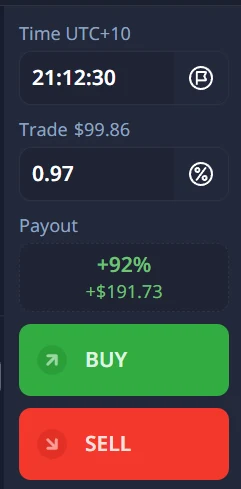
After a release, the price often swings back and forth before settling. Very short expiries (under a few minutes) leave the result to those swings. Prefer expiries of 15 minutes to an hour, which give the market time to digest the figure. A fixed expiry time can help you plan around the release:
Our article on choosing your trade duration goes further.
Keep the same amount
A big release is not a reason to invest more. Keep 1 to 2% of your capital per trade (how much to invest per trade), and do not open several trades on the same news: if the market turns, they all lose together.
Common mistakes
- Trading OTC assets as if the news applied to them.
- Reading only the headline figure and missing the revisions or the details.
- Trading every release: medium-impact figures often move the market little, and you end up trading noise.
- Doubling up after a losing news trade to win it back.
Our free lesson Make the calendar work for you explains how to build a routine around releases. And when a release surprises the market, Optencis Wire turns it into a short-term trade idea for members.
Frequently asked questions
Which news moves the market the most?
Central bank decisions (Fed, ECB, Bank of England), US inflation (CPI) and the US jobs report. They are marked as high impact in our economic calendar.
Should I trade at the exact moment of the release?
No. In the first seconds, prices jump in both directions and the result is largely chance. Waiting 5 to 15 minutes lets you see which direction the market has chosen.
Does news affect OTC assets?
Not in the way it affects the real market: OTC prices come from the platform’s own price source.
What expiry should I use after a release?
Rather 15 minutes to an hour, so the market has time to absorb the figure. Very short expiries leave too much to the swings that follow a release.
Read our binary options guide for the basics. Binary options are high-risk products: you can lose all the money you invest.