 Optencis

Binary options, CFDs and spot forex all let you trade the movements of a currency pair, an index or a commodity without owning it. The difference is in how you win and lose: with a binary option, the result is fixed in advance, all or nothing; with a CFD or a forex position, it grows or shrinks with every move of the price. That changes the risk, the costs and the rules that apply.
The comparison at a glance
| Binary options | CFDs | Forex (spot) | |
|---|---|---|---|
| What you predict | Up or down at a set time | The direction and size of the move | The direction and size of the move |
| Result of a trade | Fixed: the payout if right, the whole amount lost if wrong | Proportional to the move | Proportional to the move |
| Maximum loss per trade | The amount invested, known in advance | Can exceed the margin without a stop-loss | Can exceed the margin without a stop-loss |
| Costs | Built into the payout (below 100%) | Spread, sometimes a commission, overnight fees | Spread, sometimes a commission, overnight fees (swap) |
| Leverage | None, but each trade is all or nothing | Yes | Yes |
| Duration | Fixed: from seconds to hours | Open until you close it | Open until you close it |
An example on EUR/USD
You expect EUR/USD to rise over the next 15 minutes.
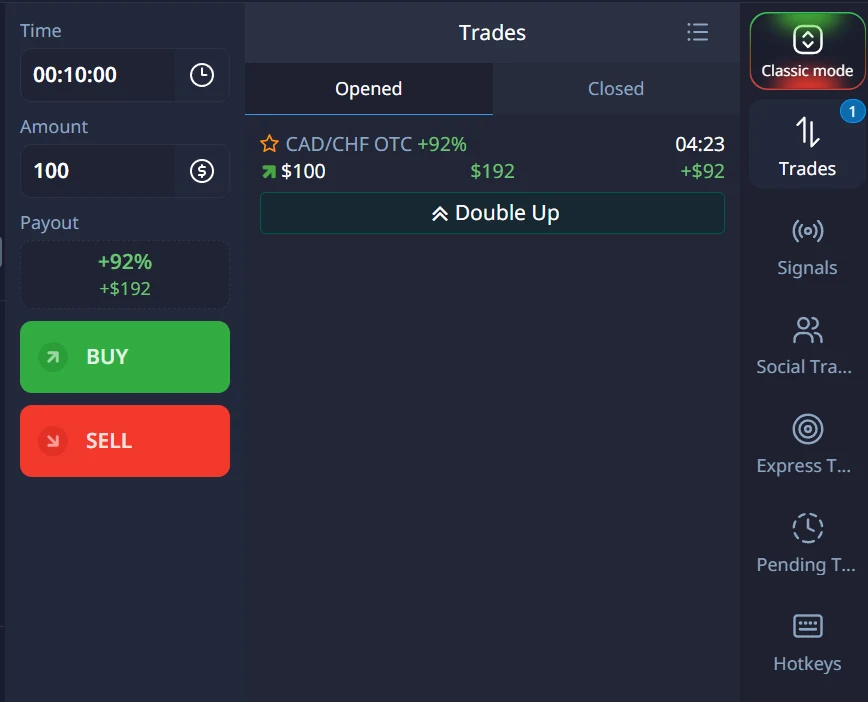
- Binary option: you invest $10 at a 90% payout. If the price is higher at expiry, even by a fraction, you receive $9 of profit. If it is lower, you lose $10. Whether the price moves by 1 pip or by 50 pips does not change the result.
- Forex or CFD position of a size where 1 pip is worth $1: if the price rises 10 pips, you gain about $10 minus the spread. If it falls 30 pips and you have no stop-loss, you lose $30, and the loss keeps growing as long as the price falls.
With a binary option, your risk is capped but your break-even win rate is above 50%: see the break-even win rate. With forex and CFDs, you can win more than you risk on a good trade, but you must manage your losses yourself, with stop-losses and position size.
Regulation
- Binary options are prohibited or restricted for retail clients in many countries, including the European Economic Area, the United Kingdom, the United States, Canada and Australia.
- CFDs are allowed for retail clients in Europe and the UK, with limits on leverage and protection against negative balances, but prohibited in the United States. Regulated brokers must publish the share of their retail clients who lose money, and it is usually well above half.
- Forex is offered by brokers regulated in most countries, with rules that vary from one country to another.
Whatever the product, check what the law allows where you live, and who supervises the broker.
Which one suits you?
- Binary options suit traders who want a fixed risk per trade and short, defined durations, and who accept that the payout makes the break-even higher than 50%.
- Forex and CFDs suit traders who can manage stop-losses, position size and overnight costs, and who want gains that grow with a good move.
In all three, the risk is real: most retail traders lose money, and the same rules apply: a measured edge, 1 to 2% of capital per trade (see how much to invest per trade), and a daily stop.
Frequently asked questions
Are binary options easier than forex?
They are simpler to understand, because each trade is up or down with a known result. They are not easier to win: the payout below 100% means you need more than 50% of winning trades.
Can you lose more than you invest?
Not with a binary option: the maximum loss is the amount of the trade. With CFDs and forex, a loss can exceed the margin, except where negative balance protection applies.
What is the difference between a CFD and forex?
A forex position is on a currency pair; a CFD is a contract on the price of almost any asset, currencies included. In practice, many brokers offer forex as CFDs.
Read our binary options guide for the basics. Binary options are high-risk products: you can lose all the money you invest.