 Optencis

In binary options, being right more than half the time is not enough. Because a win pays less than the amount invested while a loss costs all of it, you need a win rate above 1 ÷ (1 + payout) just to break even: 55.6% at an 80% payout, 52.1% at 92%. Use the calculator below with your own numbers, then read why those few points decide everything.
Break-even calculator
Your win rate is 2.9 points above your break-even.
Where the formula comes from
Take a payout p (0.92 for 92%) and a win rate w. On each trade of $1, a win brings p and a loss costs 1. You break even when your wins pay exactly for your losses:
w × p = (1 − w), so w = 1 ÷ (1 + p).
The amount per trade does not change the result: it multiplies gains and losses alike. Only the payout and your win rate count.
The break-even win rate for each payout
| Payout | Break-even win rate |
|---|---|
| 60% | 62.5% |
| 65% | 60.6% |
| 70% | 58.8% |
| 75% | 57.1% |
| 80% | 55.6% |
| 82% | 54.9% |
| 85% | 54.1% |
| 88% | 53.2% |
| 90% | 52.6% |
| 92% | 52.1% |
| 95% | 51.3% |
Your edge is the gap, not the win rate
What matters is the distance between your win rate and your break-even. Over 100 trades of $10 at a 92% payout:
- 50% right: +$460 − $500 = −$40;
- 55% right: +$506 − $450 = +$56, with an edge of only 2.9 points.
A 60% win rate looks impressive, but at a 65% payout it still loses money. A 55% win rate looks modest, but at 92% it is ahead. Always compare your win rate with the break-even of the payouts you actually traded.
How many trades before you can trust your win rate?
Over a few trades, chance dominates. A trader with no edge at all, right 50% of the time on average, still has about a 2% chance of showing 70% or more over 30 trades. Over 300 trades, the chance of showing 60% by luck alone falls to about 3 in 10,000. So judge a method on at least 100 trades taken with the same rules, written down in a trading journal.
How to widen your margin
- Choose higher payouts. Payouts vary by asset and by time of day: every point of payout lowers your break-even.
- Avoid low-payout assets. At 70%, you need nearly 59% winning trades.
- Never double after a loss. A martingale changes the shape of your results, not their average: see why the martingale ruins accounts.
- Keep the same amount per trade. See how much to invest per trade.
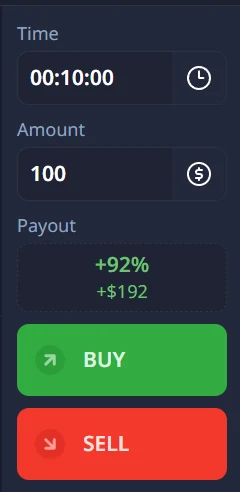
For an example on a real platform, read what a 92% payout means on Pocket Option.
Frequently asked questions
What win rate do I need at an 85% payout?
54.1%. Below that, you lose money over time; above it, you are ahead.
Is a 60% win rate good in binary options?
It depends on the payout. At 80%, the break-even is 55.6%, so 60% gives a solid edge of 4.4 points, if it holds over enough trades. At 65%, the break-even is 60.6%, and 60% loses money.
Does a martingale change the break-even?
No. Each trade keeps the same payout and the same chance of winning. Doubling the amount after a loss only makes rare large losses bigger.
Our lesson The math of break-even goes further, and our binary options guide covers the basics. Binary options are high-risk products: you can lose all the money you invest.